
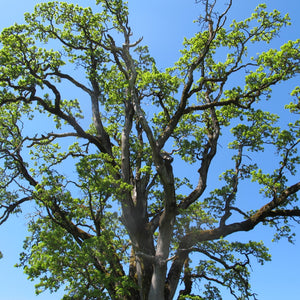
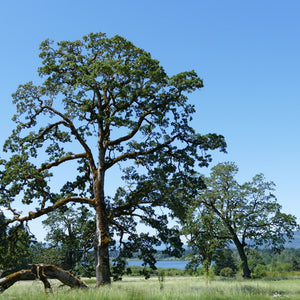
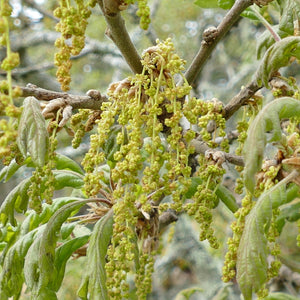
{"id":5655531618453,"title":"Quercus garryana (Garry Oak)","handle":"quercus-garryana","description":"\u003cp\u003eGarry Oak is a characteristic deciduous tree of the meadow and woodland habitats of our region. In deeper soils, it can grow up to 25 m tall, while on shallow, dry and rocky sites it may remain relatively small while still becoming very old. It has a wide ecological breadth and can be found in habitats ranging from riparian woodlands to shallow soils over bedrock.\u003c\/p\u003e\n\u003cp\u003eGarry Oak is an important habitat tree and supports a tremendous diversity of wildlife. Its bark, foliage, branches and cavities provide food and shelter for insects, birds and mammals. More than 40 local insect species feed only on Garry Oak, including the red-listed \u003ca href=\"https:\/\/satinflower.ca\/blogs\/nursery-news\/the-weekly-with-daly-overwintering-butterflies?_pos=2\u0026amp;_sid=6286f986f\u0026amp;_ss=r\" rel=\"noopener\" target=\"_blank\"\u003ePropertius Duskywing Butterfly\u003c\/a\u003e.\u003c\/p\u003e\n\u003cp\u003e\u003cstrong\u003eGrown for deep roots:\u003c\/strong\u003e When it comes to Garry Oaks, bigger isn't necessarily better. Young oaks naturally invest heavily in their root systems, developing a remarkably large root system relative to their above-ground growth. This helps them access moisture and persist through our dry summers. Keeping oaks in conventional nursery pots for too long can restrict this natural root development, leading to circling or distorted roots that may affect establishment and long-term growth.\u003c\/p\u003e\n\u003cdiv style=\"text-align: center; margin: 18px 0;\"\u003e\u003cimg src=\"https:\/\/cdn.shopify.com\/s\/files\/1\/0435\/5306\/3061\/files\/Picture1_270ea1a0-2877-4afd-ac73-b55f3a933750.jpg?v=1789165604\" alt=\"Young Garry Oak grown in a specialized deep nursery pot to support root development\" style=\"width: 100%; max-width: 400px; height: auto; display: block; margin: 0 auto;\" loading=\"lazy\"\u003e\u003c\/div\u003e\n\u003cp\u003eWe grow our Garry Oaks in specialized deep pots designed to accommodate their developing taproot and encourage a strong, well-branched root system. These containers promote air pruning rather than allowing roots to continually circle within the pot.\u003c\/p\u003e\n\u003cp\u003e\u003cstrong\u003ePlanting Garry Oaks when they are young and relatively small gives their roots a chance to establish directly in the landscape.\u003c\/strong\u003e A smaller, well-rooted tree can establish quickly and, over time, may catch up to or outperform a larger tree that has spent longer confined to a container. Once established, that root system supports increasingly vigorous above-ground growth.\u003c\/p\u003e\n\u003cp\u003eFall planting is especially beneficial in our climate, giving roots the cool, wet season to establish before the following summer. Garry Oaks are exceptionally drought-tolerant once established and, on suitable sites, established trees can persist with little or no supplemental summer irrigation.\u003c\/p\u003e\n\u003cp\u003eOur goal is not to produce the largest tree possible in a pot, but to produce a young oak with a root system well prepared for life in our local landscapes.\u003c\/p\u003e\n\n\u003cdiv style=\"border: 2px solid #212b36; padding: 14px 16px; margin: 18px 0; text-align: center;\"\u003e\n\u003cp style=\"margin: 0; font-size: 16px;\"\u003e\u003cstrong\u003e🌳 GARRY OAK 6-PACK 🌳\u003c\/strong\u003e\u003c\/p\u003e\n\u003cp style=\"margin: 6px 0 0 0;\"\u003ePurchase a case bundle of 6 for $240 — just $40 per tree (regularly $45 each).\u003c\/p\u003e\n\u003cp style=\"margin: 6px 0 0 0;\"\u003eThe 6-pack is already specially priced; additional discounts, including landscaper discounts, do not apply.\u003c\/p\u003e\n\u003c\/div\u003e\n\n\u003cdiv style=\"margin: 20px 0; text-align: center;\"\u003e\n\u003cp style=\"margin: 0;\"\u003e\u003cstrong\u003e🌿 Interested in the ecology of oaks?\u003c\/strong\u003e\u003c\/p\u003e\n\u003cp style=\"margin: 6px 0 0 0;\"\u003eDouglas Tallamy's \u003cem\u003e\u003ca href=\"https:\/\/satinflower.ca\/products\/the-nature-of-oaks-the-rich-ecology-of-our-most-essential-native-trees\"\u003eThe Nature of Oaks\u003c\/a\u003e\u003c\/em\u003e explores the remarkable diversity of life supported by oak trees throughout the seasons.\u003c\/p\u003e\n\u003cp style=\"margin: 6px 0 0 0;\"\u003e\u003cstrong\u003eThe book is currently 15% off.\u003c\/strong\u003e\u003c\/p\u003e\n\u003c\/div\u003e\n\n\u003cp\u003e\u003cstrong\u003eReference:\u003c\/strong\u003e Fuchs, M. A. 2001. \u003cem\u003eTowards a Recovery Strategy for Garry Oak and Associated Ecosystems in Canada: Ecological Assessment and Literature Review.\u003c\/em\u003e Technical Report GBEI\/EC-00-030. Environment Canada, Canadian Wildlife Service, Pacific and Yukon Region.\u003c\/p\u003e\n\u003cp\u003e\u003cstrong\u003eNote:\u003c\/strong\u003e This plant is rich in local Indigenous food traditions. We strongly recommend that non-Indigenous people take time to learn about these traditions and the appropriate use of this and other native plants. A useful resource is \u003cstrong\u003e\u003ca href=\"https:\/\/publications.royalbcmuseum.bc.ca\/product\/saanich-ethnobotany\/\"\u003eSaanich Ethnobotany\u003c\/a\u003e\u003c\/strong\u003e by Nancy Turner and Richard Hebda.\u003c\/p\u003e\n\u003cp\u003e\u003cem\u003e*Edibility depends on the preparation of the plant. Always do your own research prior to consuming plant parts and eat at your own risk.\u003c\/em\u003e\u003c\/p\u003e\n\u003cdiv id=\"sfncontainer\"\u003e\n\u003cbutton type=\"button\" class=\"accordion\"\u003ePlant Details\u003c\/button\u003e\n\u003cdiv class=\"accordion-panel\"\u003e\n\u003ctable class=\"single_plant_view\"\u003e\n\u003ctbody\u003e\n\u003ctr\u003e\n\u003cth class=\"right\"\u003ehabitat\u003c\/th\u003e\n\u003ctd class=\"left\"\u003eMeadows, woodlands, and rocky slopes\u003c\/td\u003e\n\u003c\/tr\u003e\n\u003ctr\u003e\n\u003cth class=\"right\"\u003elight\u003c\/th\u003e\n\u003ctd class=\"left\"\u003eFull sun\u003c\/td\u003e\n\u003c\/tr\u003e\n\u003ctr\u003e\n\u003cth class=\"right\"\u003emoisture\u003c\/th\u003e\n\u003ctd class=\"left\"\u003eDry to moist\u003c\/td\u003e\n\u003c\/tr\u003e\n\u003ctr\u003e\n\u003cth class=\"right\"\u003eheight\u003c\/th\u003e\n\u003ctd class=\"left\"\u003eUp to 25 m\u003c\/td\u003e\n\u003c\/tr\u003e\n\u003ctr\u003e\n\u003cth class=\"right\"\u003eflowering\u003c\/th\u003e\n\u003ctd class=\"left\"\u003eApril to May\u003c\/td\u003e\n\u003c\/tr\u003e\n\u003ctr\u003e\n\u003cth class=\"right\"\u003ehabit\u003c\/th\u003e\n\u003ctd class=\"left\"\u003eDeciduous tree\u003c\/td\u003e\n\u003c\/tr\u003e\n\u003ctr\u003e\n\u003cth class=\"right\"\u003efeature\u003c\/th\u003e\n\u003ctd class=\"left\"\u003eAttracts birds and insects, butterfly host, drought-tolerant\u003c\/td\u003e\n\u003c\/tr\u003e\n\u003ctr\u003e\n\u003cth class=\"right\"\u003ecompanion plants\u003c\/th\u003e\n\u003ctd class=\"left\"\u003e\n\u003ca href=\"https:\/\/satinflower.ca\/products\/camassia-leichtlinii?_pos=1\u0026amp;_psq=great%20ca\u0026amp;_ss=e\u0026amp;_v=1.0\"\u003eGreat Camas\u003c\/a\u003e, \u003ca href=\"https:\/\/satinflower.ca\/products\/camassia-quamash?_pos=1\u0026amp;_psq=common%20cama\u0026amp;_ss=e\u0026amp;_v=1.0\"\u003eCommon Camas\u003c\/a\u003e, \u003ca href=\"https:\/\/satinflower.ca\/products\/ranunculus-occidentalis?_pos=1\u0026amp;_psq=western\u0026amp;_ss=e\u0026amp;_v=1.0\"\u003eWestern Buttercup\u003c\/a\u003e, \u003ca href=\"https:\/\/satinflower.ca\/products\/primula-hendersonii?_pos=2\u0026amp;_psq=broad%20lea\u0026amp;_ss=e\u0026amp;_v=1.0\"\u003eBroad-leaved Shootingstar\u003c\/a\u003e, \u003ca href=\"https:\/\/satinflower.ca\/products\/triteleia-hyacinthina?_pos=1\u0026amp;_psq=fools\u0026amp;_ss=e\u0026amp;_v=1.0\"\u003eFool's Onion\u003c\/a\u003e, \u003ca href=\"https:\/\/satinflower.ca\/products\/bromus-carinatus?_pos=1\u0026amp;_psq=california%20br\u0026amp;_ss=e\u0026amp;_v=1.0\"\u003eCalifornia Brome\u003c\/a\u003e\n\u003c\/td\u003e\n\u003c\/tr\u003e\n\u003c\/tbody\u003e\n\u003c\/table\u003e\n\u003c\/div\u003e\n\u003c\/div\u003e","published_at":"2020-08-27T12:16:44-07:00","created_at":"2020-08-27T12:16:44-07:00","vendor":"Saanich Native Plants","type":"plant","tags":["BLOOMTIME_Apr-Jun","FEATURE_attracts birds","FEATURE_butterfly host","FEATURE_butterfly-friendly","FEATURE_deciduous","FEATURE_drought-tolerant","FORM_tree","HABITAT_meadow","HABITAT_rocky","HABITAT_woodland","HEIGHT_5 m +","LIGHT_sun","SOIL_dry","SOIL_mesic","SOIL_moist"],"price":4500,"price_min":4500,"price_max":24000,"available":true,"price_varies":true,"compare_at_price":null,"compare_at_price_min":0,"compare_at_price_max":0,"compare_at_price_varies":false,"variants":[{"id":47139588538601,"title":"1.3 Gallon DEEP POT","option1":"1.3 Gallon DEEP POT","option2":null,"option3":null,"sku":"quercus-garryana-1.3gal_deep","requires_shipping":true,"taxable":true,"featured_image":null,"available":true,"name":"Quercus garryana (Garry Oak) - 1.3 Gallon DEEP POT","public_title":"1.3 Gallon DEEP POT","options":["1.3 Gallon DEEP POT"],"price":4500,"weight":0,"compare_at_price":null,"inventory_management":"shopify","barcode":null,"requires_selling_plan":false,"selling_plan_allocations":[],"quantity_rule":{"min":1,"max":null,"increment":1}},{"id":51866075988201,"title":"1.3 Gallon DEEP POT – 6 PACK","option1":"1.3 Gallon DEEP POT – 6 PACK","option2":null,"option3":null,"sku":null,"requires_shipping":true,"taxable":true,"featured_image":null,"available":true,"name":"Quercus garryana (Garry Oak) - 1.3 Gallon DEEP POT – 6 PACK","public_title":"1.3 Gallon DEEP POT – 6 PACK","options":["1.3 Gallon DEEP POT – 6 PACK"],"price":24000,"weight":0,"compare_at_price":null,"inventory_management":"shopify","barcode":null,"requires_selling_plan":false,"selling_plan_allocations":[],"quantity_rule":{"min":1,"max":null,"increment":1}}],"images":["\/\/satinflower.ca\/cdn\/shop\/products\/quercusgarryana_Custom.jpg?v=1616177826","\/\/satinflower.ca\/cdn\/shop\/products\/quercusgarryana2_Custom.jpg?v=1616177826","\/\/satinflower.ca\/cdn\/shop\/products\/quercusgarryana3_Custom.jpg?v=1616177826","\/\/satinflower.ca\/cdn\/shop\/files\/Picture2_d1606561-37b9-4501-9382-7387e2d9a41a.jpg?v=1789165604"],"featured_image":"\/\/satinflower.ca\/cdn\/shop\/products\/quercusgarryana_Custom.jpg?v=1616177826","options":["Size"],"media":[{"alt":null,"id":21156667719829,"position":1,"preview_image":{"aspect_ratio":1.0,"height":1140,"width":1140,"src":"\/\/satinflower.ca\/cdn\/shop\/products\/quercusgarryana_Custom.jpg?v=1616177826"},"aspect_ratio":1.0,"height":1140,"media_type":"image","src":"\/\/satinflower.ca\/cdn\/shop\/products\/quercusgarryana_Custom.jpg?v=1616177826","width":1140},{"alt":null,"id":21156667752597,"position":2,"preview_image":{"aspect_ratio":1.0,"height":1140,"width":1140,"src":"\/\/satinflower.ca\/cdn\/shop\/products\/quercusgarryana2_Custom.jpg?v=1616177826"},"aspect_ratio":1.0,"height":1140,"media_type":"image","src":"\/\/satinflower.ca\/cdn\/shop\/products\/quercusgarryana2_Custom.jpg?v=1616177826","width":1140},{"alt":null,"id":21156667785365,"position":3,"preview_image":{"aspect_ratio":1.0,"height":1140,"width":1140,"src":"\/\/satinflower.ca\/cdn\/shop\/products\/quercusgarryana3_Custom.jpg?v=1616177826"},"aspect_ratio":1.0,"height":1140,"media_type":"image","src":"\/\/satinflower.ca\/cdn\/shop\/products\/quercusgarryana3_Custom.jpg?v=1616177826","width":1140},{"alt":null,"id":40892360917225,"position":4,"preview_image":{"aspect_ratio":1.003,"height":2475,"width":2482,"src":"\/\/satinflower.ca\/cdn\/shop\/files\/Picture2_d1606561-37b9-4501-9382-7387e2d9a41a.jpg?v=1789165604"},"aspect_ratio":1.003,"height":2475,"media_type":"image","src":"\/\/satinflower.ca\/cdn\/shop\/files\/Picture2_d1606561-37b9-4501-9382-7387e2d9a41a.jpg?v=1789165604","width":2482}],"requires_selling_plan":false,"selling_plan_groups":[],"content":"\u003cp\u003eGarry Oak is a characteristic deciduous tree of the meadow and woodland habitats of our region. In deeper soils, it can grow up to 25 m tall, while on shallow, dry and rocky sites it may remain relatively small while still becoming very old. It has a wide ecological breadth and can be found in habitats ranging from riparian woodlands to shallow soils over bedrock.\u003c\/p\u003e\n\u003cp\u003eGarry Oak is an important habitat tree and supports a tremendous diversity of wildlife. Its bark, foliage, branches and cavities provide food and shelter for insects, birds and mammals. More than 40 local insect species feed only on Garry Oak, including the red-listed \u003ca href=\"https:\/\/satinflower.ca\/blogs\/nursery-news\/the-weekly-with-daly-overwintering-butterflies?_pos=2\u0026amp;_sid=6286f986f\u0026amp;_ss=r\" rel=\"noopener\" target=\"_blank\"\u003ePropertius Duskywing Butterfly\u003c\/a\u003e.\u003c\/p\u003e\n\u003cp\u003e\u003cstrong\u003eGrown for deep roots:\u003c\/strong\u003e When it comes to Garry Oaks, bigger isn't necessarily better. Young oaks naturally invest heavily in their root systems, developing a remarkably large root system relative to their above-ground growth. This helps them access moisture and persist through our dry summers. Keeping oaks in conventional nursery pots for too long can restrict this natural root development, leading to circling or distorted roots that may affect establishment and long-term growth.\u003c\/p\u003e\n\u003cdiv style=\"text-align: center; margin: 18px 0;\"\u003e\u003cimg src=\"https:\/\/cdn.shopify.com\/s\/files\/1\/0435\/5306\/3061\/files\/Picture1_270ea1a0-2877-4afd-ac73-b55f3a933750.jpg?v=1789165604\" alt=\"Young Garry Oak grown in a specialized deep nursery pot to support root development\" style=\"width: 100%; max-width: 400px; height: auto; display: block; margin: 0 auto;\" loading=\"lazy\"\u003e\u003c\/div\u003e\n\u003cp\u003eWe grow our Garry Oaks in specialized deep pots designed to accommodate their developing taproot and encourage a strong, well-branched root system. These containers promote air pruning rather than allowing roots to continually circle within the pot.\u003c\/p\u003e\n\u003cp\u003e\u003cstrong\u003ePlanting Garry Oaks when they are young and relatively small gives their roots a chance to establish directly in the landscape.\u003c\/strong\u003e A smaller, well-rooted tree can establish quickly and, over time, may catch up to or outperform a larger tree that has spent longer confined to a container. Once established, that root system supports increasingly vigorous above-ground growth.\u003c\/p\u003e\n\u003cp\u003eFall planting is especially beneficial in our climate, giving roots the cool, wet season to establish before the following summer. Garry Oaks are exceptionally drought-tolerant once established and, on suitable sites, established trees can persist with little or no supplemental summer irrigation.\u003c\/p\u003e\n\u003cp\u003eOur goal is not to produce the largest tree possible in a pot, but to produce a young oak with a root system well prepared for life in our local landscapes.\u003c\/p\u003e\n\n\u003cdiv style=\"border: 2px solid #212b36; padding: 14px 16px; margin: 18px 0; text-align: center;\"\u003e\n\u003cp style=\"margin: 0; font-size: 16px;\"\u003e\u003cstrong\u003e🌳 GARRY OAK 6-PACK 🌳\u003c\/strong\u003e\u003c\/p\u003e\n\u003cp style=\"margin: 6px 0 0 0;\"\u003ePurchase a case bundle of 6 for $240 — just $40 per tree (regularly $45 each).\u003c\/p\u003e\n\u003cp style=\"margin: 6px 0 0 0;\"\u003eThe 6-pack is already specially priced; additional discounts, including landscaper discounts, do not apply.\u003c\/p\u003e\n\u003c\/div\u003e\n\n\u003cdiv style=\"margin: 20px 0; text-align: center;\"\u003e\n\u003cp style=\"margin: 0;\"\u003e\u003cstrong\u003e🌿 Interested in the ecology of oaks?\u003c\/strong\u003e\u003c\/p\u003e\n\u003cp style=\"margin: 6px 0 0 0;\"\u003eDouglas Tallamy's \u003cem\u003e\u003ca href=\"https:\/\/satinflower.ca\/products\/the-nature-of-oaks-the-rich-ecology-of-our-most-essential-native-trees\"\u003eThe Nature of Oaks\u003c\/a\u003e\u003c\/em\u003e explores the remarkable diversity of life supported by oak trees throughout the seasons.\u003c\/p\u003e\n\u003cp style=\"margin: 6px 0 0 0;\"\u003e\u003cstrong\u003eThe book is currently 15% off.\u003c\/strong\u003e\u003c\/p\u003e\n\u003c\/div\u003e\n\n\u003cp\u003e\u003cstrong\u003eReference:\u003c\/strong\u003e Fuchs, M. A. 2001. \u003cem\u003eTowards a Recovery Strategy for Garry Oak and Associated Ecosystems in Canada: Ecological Assessment and Literature Review.\u003c\/em\u003e Technical Report GBEI\/EC-00-030. Environment Canada, Canadian Wildlife Service, Pacific and Yukon Region.\u003c\/p\u003e\n\u003cp\u003e\u003cstrong\u003eNote:\u003c\/strong\u003e This plant is rich in local Indigenous food traditions. We strongly recommend that non-Indigenous people take time to learn about these traditions and the appropriate use of this and other native plants. A useful resource is \u003cstrong\u003e\u003ca href=\"https:\/\/publications.royalbcmuseum.bc.ca\/product\/saanich-ethnobotany\/\"\u003eSaanich Ethnobotany\u003c\/a\u003e\u003c\/strong\u003e by Nancy Turner and Richard Hebda.\u003c\/p\u003e\n\u003cp\u003e\u003cem\u003e*Edibility depends on the preparation of the plant. Always do your own research prior to consuming plant parts and eat at your own risk.\u003c\/em\u003e\u003c\/p\u003e\n\u003cdiv id=\"sfncontainer\"\u003e\n\u003cbutton type=\"button\" class=\"accordion\"\u003ePlant Details\u003c\/button\u003e\n\u003cdiv class=\"accordion-panel\"\u003e\n\u003ctable class=\"single_plant_view\"\u003e\n\u003ctbody\u003e\n\u003ctr\u003e\n\u003cth class=\"right\"\u003ehabitat\u003c\/th\u003e\n\u003ctd class=\"left\"\u003eMeadows, woodlands, and rocky slopes\u003c\/td\u003e\n\u003c\/tr\u003e\n\u003ctr\u003e\n\u003cth class=\"right\"\u003elight\u003c\/th\u003e\n\u003ctd class=\"left\"\u003eFull sun\u003c\/td\u003e\n\u003c\/tr\u003e\n\u003ctr\u003e\n\u003cth class=\"right\"\u003emoisture\u003c\/th\u003e\n\u003ctd class=\"left\"\u003eDry to moist\u003c\/td\u003e\n\u003c\/tr\u003e\n\u003ctr\u003e\n\u003cth class=\"right\"\u003eheight\u003c\/th\u003e\n\u003ctd class=\"left\"\u003eUp to 25 m\u003c\/td\u003e\n\u003c\/tr\u003e\n\u003ctr\u003e\n\u003cth class=\"right\"\u003eflowering\u003c\/th\u003e\n\u003ctd class=\"left\"\u003eApril to May\u003c\/td\u003e\n\u003c\/tr\u003e\n\u003ctr\u003e\n\u003cth class=\"right\"\u003ehabit\u003c\/th\u003e\n\u003ctd class=\"left\"\u003eDeciduous tree\u003c\/td\u003e\n\u003c\/tr\u003e\n\u003ctr\u003e\n\u003cth class=\"right\"\u003efeature\u003c\/th\u003e\n\u003ctd class=\"left\"\u003eAttracts birds and insects, butterfly host, drought-tolerant\u003c\/td\u003e\n\u003c\/tr\u003e\n\u003ctr\u003e\n\u003cth class=\"right\"\u003ecompanion plants\u003c\/th\u003e\n\u003ctd class=\"left\"\u003e\n\u003ca href=\"https:\/\/satinflower.ca\/products\/camassia-leichtlinii?_pos=1\u0026amp;_psq=great%20ca\u0026amp;_ss=e\u0026amp;_v=1.0\"\u003eGreat Camas\u003c\/a\u003e, \u003ca href=\"https:\/\/satinflower.ca\/products\/camassia-quamash?_pos=1\u0026amp;_psq=common%20cama\u0026amp;_ss=e\u0026amp;_v=1.0\"\u003eCommon Camas\u003c\/a\u003e, \u003ca href=\"https:\/\/satinflower.ca\/products\/ranunculus-occidentalis?_pos=1\u0026amp;_psq=western\u0026amp;_ss=e\u0026amp;_v=1.0\"\u003eWestern Buttercup\u003c\/a\u003e, \u003ca href=\"https:\/\/satinflower.ca\/products\/primula-hendersonii?_pos=2\u0026amp;_psq=broad%20lea\u0026amp;_ss=e\u0026amp;_v=1.0\"\u003eBroad-leaved Shootingstar\u003c\/a\u003e, \u003ca href=\"https:\/\/satinflower.ca\/products\/triteleia-hyacinthina?_pos=1\u0026amp;_psq=fools\u0026amp;_ss=e\u0026amp;_v=1.0\"\u003eFool's Onion\u003c\/a\u003e, \u003ca href=\"https:\/\/satinflower.ca\/products\/bromus-carinatus?_pos=1\u0026amp;_psq=california%20br\u0026amp;_ss=e\u0026amp;_v=1.0\"\u003eCalifornia Brome\u003c\/a\u003e\n\u003c\/td\u003e\n\u003c\/tr\u003e\n\u003c\/tbody\u003e\n\u003c\/table\u003e\n\u003c\/div\u003e\n\u003c\/div\u003e"}
Quercus garryana Garry Oak



Growing From Seed
Growing your own native plants from seed is the most economical way to add natives to your project or home garden. The seeds of native plants have built-in dormancy mechanisms that protect them from germinating before killing frosts or periods of drought.
In cultivation, the successful gardener must become familiar with these conditions to unlock the dormancy mechanism and stimulate germination. We are developing thorough seed germination categories in the Seed Details section above to help you successfully grow the native seed we sell.
Download: Seed Starting Basics Guide
Growing from Potted Plants
Careful and correct planting techniques are critical to the survival of young potted plants from our nursery.
Download: Planting and Care of Potted Plants