A Summer of Learning: Reflections from a Pollinator Internship

This summer, Riley Timmer joined Pollinator Partnership Canada and Satinflower Nurseries as a pollinator intern through Canada Summer Jobs, helping to document the insects visiting our native seed fields while learning from researchers, educators, and restoration practitioners. In the blog below, Riley reflects on his experiences, the people who inspired him, and how a summer spent exploring the connections between plants and pollinators deepened his passion for pollinator conservation.
Throughout my time with Satinflower Nurseries and Pollinator Partnership Canada, I have learned an incredible amount about how native plants support pollinator diversity and, in turn, how pollinators support both our agricultural systems and natural ecosystems.

at Pollinator Partnership.
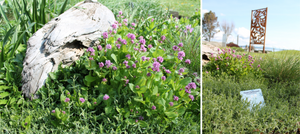
I began my learning by attending the Native Hedgerows for Habitat: Farms, Pollinators, and Native Plants workshop, hosted by Habitat Acquisition Trust and Sea Bluff Farm. There, I learned about the important relationship between pollinator diversity and agriculture. Approximately one-third of the food we eat depends on pollination, making healthy pollinator communities essential to food production.
While many farmers rely on managed honey bee hives for pollination, diseases, parasites, and other challenges can make this approach less reliable. Native hedgerows provide habitat for a diverse community of wild pollinators, helping to ensure crops are pollinated throughout the growing season.
During the workshop, Dr. Lora Morandin, Associate Director at Pollinator Partnership, explained that many native bees forage at least 200 metres from a hedgerow and are often more efficient pollinators than honey bees. By supporting native pollinators, hedgerows can increase the resilience and reliability of pollination services while providing a cost-effective, scalable solution for farmers.

during Mini Bee School with the Native Bee Society of British Columbia .
Photo: Riley Timmer.
Throughout my time with Master Melittologists Jade Lee and Gwendolyn Williams from the Native Bee Society of British Columbia, I began to understand the incredible diversity of native bees and the characteristics used to distinguish one family from another. I also came to appreciate why part of my research involved collecting bees for identification.
Much of this process relies on using a dichotomous key, which guides you through a series of identifying characteristics to narrow a specimen down to its species. These features can be surprisingly subtle, such as the number of spurs on a leg or the arrangement of cells in a wing. Careful identification often requires a microscope, and even then, it can be challenging. Many experts dedicate their entire careers to studying just a single family of bees.

with Dr. Lora Morandin, Associate Director at Pollinator Partnership .
Photo: Riley Timmer.
After learning these identification techniques, I had the opportunity to apply them while collecting pollinator data. On a typical collection day, I began with a 10-minute observation period, photographing as many insects as possible visiting a target plant species. This was followed by a 10-minute timed collection, during which I swept along the row to collect insects while recording any individuals I was unable to catch, as well as any duplicates or species that could be confidently identified in the field.
This sampling protocol was repeated six times each day, with every plant species surveyed twice: once in the morning and once in the evening. Sampling at different times of day helped capture changes in pollinator communities, as insect activity varies with weather conditions and the time of day.
Before each survey, I selected which plant species to sample based on which flowers were in bloom, as well as factors such as weather, plant structure, and pollinator activity. Spending time observing and collecting pollinators helped reinforce what I had learned and gave me a much greater appreciation for the diversity and complexity of these communities.

observation vial at a Satinflower Nurseries seed field.
Photo: Riley Timmer.
After spending time learning to identify native bees in the field, I continued building my knowledge at the Pollinator Steward Certification Training Workshop, organized by Pollinator Partnership in collaboration with the City of Victoria, where I earned my Pollinator Steward Certificate.
The workshop was fascinating and expanded my understanding of pollinators far beyond bees. I learned that pollination is carried out by an incredible diversity of animals, including flies, beetles, butterflies, moths, birds, bats, lizards, and even Ethiopian wolves. We also explored the importance of pollinator habitat, methods for monitoring pollinators, and practical ways communities can support pollinators through habitat creation and stewardship.
One of my favourite sessions focused on identifying bees, wasps, and flies using key characteristics. Before I explain some of those features, take a look at the photos below and see if you can guess whether each photo is a wasp, a bee, or a fly.


If you guessed bee, bee, and fly, you were right!
Photos: Riley Timmer.
One quick tip for identification is to look at the eyes. Flies often have large, bulbous eyes that may meet at the top of the head, particularly in males. Bees generally have more oval or almond-shaped eyes, while many wasps have eyes with a noticeable notch, giving them a distinct two-lobed appearance.

One of our most common pollinating beetles, and always a joyful sight in the field.
Photo: Riley Timmer.
During the Pollinator Steward Certification workshop, I also had the opportunity to learn from W̱JOȽEȽP (Tsartlip First Nation) Knowledge Keeper Beangka Elliott and lək̓ʷəŋən Knowledge Keeper Loreisa Lepine.
Their teachings encouraged me to think more deeply about what it means to build a relationship with the land.
Beangka encouraged us to consider what it means to have a relationship with the land. Although I had thought about this before, the discussion renewed my determination to learn how to live in a more reciprocal way and reminded me to stay grounded in my own relationship with place.
I was also deeply moved by Loreisa's stories about the stewardship of culturally important plants. Hearing about the care involved in tending these plants and the impact of their loss reminded me that ecological restoration is about far more than restoring ecosystems. It is also about relationships, responsibility, respect, and caring for the places that sustain us.
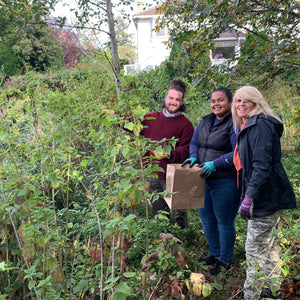
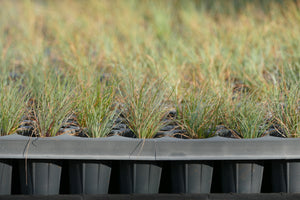
In the weeks that followed, I found myself reflecting on these teachings while working with plants at Satinflower Nurseries' Saanich location, volunteering to remove invasive species, and spending time with the UVic Ecological Restoration Club Nursery. It reinforced that restoration is not simply about growing plants, but about how we choose to care for the land and the communities connected to it.

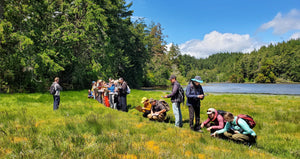
on lək̓ʷəŋən territory, where MeadowMakers participants explored native meadow restoration.
Photo: Riley Timmer.
To bring these experiences together, I had the opportunity to participate in the final MeadowMakers workshop of the season, Satinflower Nurseries' educational program focused on creating, restoring, and caring for native meadows. The workshop was held at the Garry Oak Learning Meadow at Fort Rodd Hill National Historic Site.
The experience felt like a full-circle moment, bringing together everything I had been learning about plants, pollinators, people, and restoration. During a discussion about the relationship between the California Bumble Bee and the Golden Paintbrush, and how much we still have to learn about their interactions, I realized I had truly come to love pollinators not only for their inherent value, but also for the questions they inspire me to ask.
This experience showed me where I still have room to grow while opening new paths that I am excited to pursue. I leave this summer grateful to all the people I met who made this field of work so welcoming, inspiring, and full of curiosity.
I am excited to keep learning, and I hope you might feel inspired to look a little more closely at the plants and pollinators around you, too.

- Satinflower Nurseries