Native Pollinator Gardens at the Shaw Centre for the Salish Sea

Have you had the chance to visit the Shaw Centre for the Salish Sea in Sidney? The not-for-profit aquarium and marine education science centre showcases the rich biodiversity of the Salish Sea through immersive exhibits focused on coastal ecology, conservation, and marine life. The Centre’s current exhibit, Wild Allies: Native Plants & Pollinators, celebrates the remarkable diversity of native plants and pollinators in the Salish Sea bioregion, while exploring how these species have co-evolved over time and continue to support healthy ecosystems and communities today.


The exhibit features artwork and photography by W̱SÍḴEM artist Sarah Jim and other local artists and naturalists, including Briony Penn, Kayla Johnson, Lynda Stevens, and Joe Dlugo, alongside stories and examples of ecological restoration projects making a difference locally.

A peek inside the Wild Allies exhibit.
Beyond the indoor displays, Wild Allies extends outdoors into a native pollinator garden in Beacon Park just outside the aquarium, which I had the honour of designing, planting and maintaining with the aquarium’s Director of Exhibits & Engagement, Leah Thorpe, over the past year. The garden features interpretive signage and decal artwork by W̱SÍḴEM artist Sarah Jim, helping visitors connect with the cultural and ecological relationships reflected throughout the exhibit.
Excitingly, this garden will remain in place as a living legacy of the exhibit and will soon expand to include a larger coastal pollinator garden surrounding outdoor tide pool tanks! These new plantings will include species native to backshore beach, salt marsh, and coastal bluff habitats characteristic of Southern Vancouver Island and the Gulf Islands.
Design elements of these pollinator gardens include:
- Planting larger patches of individual plant species to help attract pollinators with specific plant preferences and incorporating host plants for local butterflies.
- Ensuring a diverse mix of species with bloom times that extend from early spring to fall
- Creating structural diversity by including plants that vary in height, colour, and texture.
- Incorporating hollow-stemmed species, such as Camas and Barestem Desert-parsley, to provide overwintering habitat for cavity-nesting bees.
- Leaving some areas of bare, unplanted soil for ground-nesting bees.
- Adding driftwood logs to provide resting, sunning, and perching sites for bees, butterflies and other pollinators.


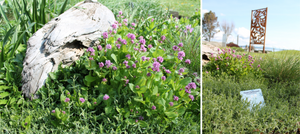
The original planting of non-native annuals and perennials (left), and the same garden bed replanted with native species, along with signage and decal artwork by W̱SÍḴEM artist Sarah Jim (right).
Ensuring the long-term health and success of pollinator gardens in public spaces requires a thoughtful maintenance strategy grounded in collaboration and shared responsibility among its project partners. In this case, we worked closely with The Shaw Centre for the Salish Sea and the Town of Sidney Parks staff. During the garden’s first year, I conducted six maintenance visits alongside these partners, creating valuable opportunities to share knowledge on species-specific plant care and life-cycle considerations. With this foundation in place, the aquarium and municipal gardening staff are now well-positioned to take over the garden’s long-term care.
Witnessing the pollinator garden grow and attract increasing numbers of pollinators over its first year has been both rewarding and motivating, highlighting the potential to create more habitat in urban parks. Many thanks to The Shaw Centre for the Salish Sea, Sarah Jim, and the Town of Sidney for their support in making this pollinator garden project a growing success!
Wild Allies: Native Plants & Pollinators will run until Summer 2026, but you can visit the outdoor pollinator garden anytime. The garden expansion project is scheduled for planting in fall 2026–stay tuned!


Julia and Kristen are planting the garden pollinator garden in December 2024 (left). Julia and Leah at the Wild Allies grand opening in March 2025 (right).


A feast of colours and textures. Spring and summer 2025 in the pollinator garden.


July 2025. A Vancouver Island Bumblebee (Bombus vancouverensis ssp. vancouverensis) visiting Nodding Onion, and Yellow-faced Bumblebee (Bombus vosnesenskii) visiting California Aster.

November 2025. Note the germination of Farewell-to-Spring (an annual) under the empty seed heads from the parent plants that bloomed last spring.

Julia with the pollinator garden in April 2026. The site of the upcoming coastal pollinator expansion project is shown in the background.


Site of coastal pollinator garden explanation project, scheduled for Planting in fall 2026!
Written by Julia Daly, Senior Propagation and Restoration Specialist, Satinflower Nurseries
- Julia Daly